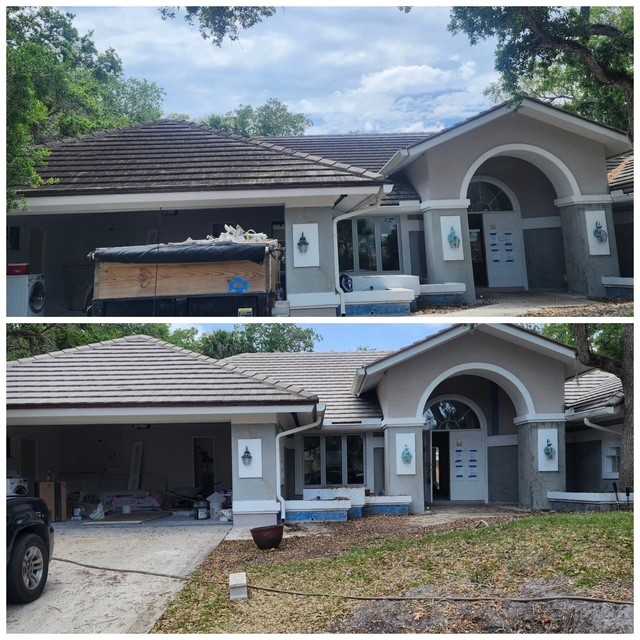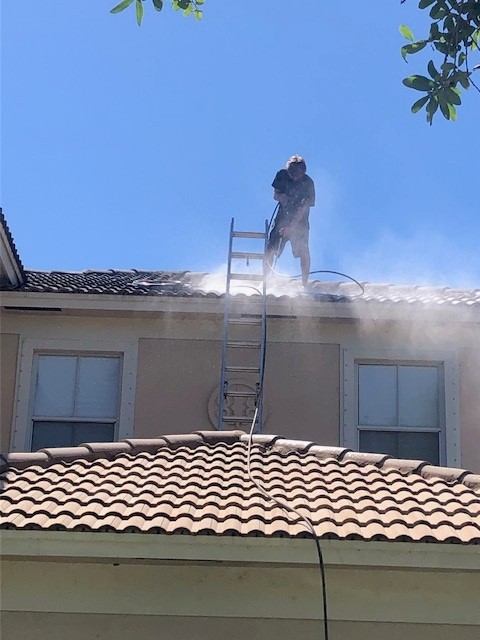
If your Treasure Coast roof is streaked black or spotted with green, you are seeing living organisms, not dirt. Roof cleaning removes algae, mold, and lichen that thrive in Florida's heat and humidity, and the safe method here is soft washing rather than high pressure. Doing it right protects both your roof's appearance and its lifespan, and it is one of the highest-impact things you can do for curb appeal.
Why do Florida roofs get so dirty?
Three local conditions gang up on your roof. First, humidity and frequent rain keep surfaces damp, which is exactly what algae needs. Second, salt air drifting in from the Atlantic and the Indian River Lagoon settles on roofing and holds moisture. Third, our intense sun bakes organic growth into a stubborn film. Add shade from live oaks and the streaks appear even faster, especially on the north side of the roof that dries slowest.
The black stains are Gloeocapsa magma, a hardy algae that eats the mineral filler in asphalt shingles. The green fuzz is often mold or a younger algae, and the crusty raised spots are lichen, which is the hardest to remove because it anchors into the surface. Each responds to the right cleaning solution, but none rinse off with a garden hose.
Is a dirty roof actually a problem?
Yes, beyond curb appeal. Algae holds moisture against the roof and can accelerate granule loss on shingles, while dark streaks absorb heat and can push cooling costs up during our long summers. On tile roofs, organic growth traps debris and moisture in the valleys. HOAs across Vero Beach and Port St. Lucie also cite homeowners for stained roofs, so letting it go can turn into a compliance letter. And buyers notice a streaked roof immediately, which matters if you plan to sell.
Why salt air makes it worse
Coastal homes in Vero Beach, Sebastian, and along the barrier island deal with a salty film that ordinary rain does not fully wash off. That film keeps the roof surface damp longer and gives algae a steady foothold. Homes within a few miles of the water almost always need cleaning sooner than inland properties. It is one reason a generic national guide rarely fits a Treasure Coast roof, and why a local crew that has seen thousands of coastal roofs gives better advice.
What should a proper roof cleaning include?
- Soft washing with low pressure so shingle granules and tile stay intact.
- Algaecidal solution that kills growth at the root instead of just rinsing the top layer.
- Plant protection, with landscaping pre-soaked and rinsed afterward.
- A safety-first crew that is insured and trained to work at height.
- A quick inspection that flags loose tiles, worn flashing, or clogged valleys.
You can read more about our approach on the roof cleaning page, and homeowners near the water may also want to look at house soft washing since the same salt film stains siding and stucco.
How often and what it costs
Most Treasure Coast roofs do well with a soft wash every 2 to 4 years, sooner if you are near the coast or under heavy tree cover. Pricing depends on roof size, pitch, height, material, and how heavy the growth is, so any honest quote comes after a look at the property rather than a flat number over the phone. Beware anyone quoting to pressure wash your shingles cheaply; that shortcut costs you far more in shingle life.
Choosing the right company
Ask whether they soft wash or pressure wash, whether they carry insurance, and how they protect your plants. A local crew that knows Indian River and St. Lucie County conditions will give you a straighter answer than an out-of-town outfit. MainSail Pressure Washing has served the area for over a decade and is fully insured, and we are happy to walk you through the plan before we start.
Prevention between cleanings
Once your roof is clean, a few habits help it stay that way longer on the Treasure Coast. Keep tree branches trimmed back so the roof gets more sun and dries faster after rain, which slows algae. Keep the gutters flowing so water does not back up onto the lower edge of the roof and feed growth in the valleys. Some homeowners install zinc or copper strips near the ridge, which release trace metals that discourage algae as rain washes over the surface. None of these replace periodic soft washing, but together they can meaningfully stretch the time between cleanings and protect the investment you just made in your roof.
Ready to get the streaks off and protect your roof? Call MainSail Pressure Washing at (772) 559-2666 for a free estimate. We serve Vero Beach, Sebastian, Fort Pierce, and Port St. Lucie 7 days a week.